Construction projects bring together a coalition of independent companies. Owners, general contractors, subcontractors, architects, and engineers arrive with their own records, obligations, and a stake in the outcome. A Common Data Environment (CDE) promises to bring that information into a single place, so the whole project team works from current, accurate records. The construction industry has largely settled on this idea. However, there is one question left unanswered: When project information lives in a shared space, who holds it, and what becomes of those records over the life of the work?
For a job with many companies involved, the answer decides whether a CDE serves the full team or only the company that hosts it.
Common Data Environment Summary
A Common Data Environment is where a construction project's information comes together, and on a job with many companies, what matters most is who keeps a hold on that information.
- A CDE collects, manages, and shares construction project information, so the team works from current records with version control and a full audit history.
- The standard model puts one company in the host role and brings other firms in as guests, which leaves data silos at the seams between organizations.
- A connected model lets construction organizations keep control of their records while contributing to a single project record, so collaboration strengthens the work without taking control away from anyone.
- ISO 19650 builds this principle into the concept of a CDE by keeping information under the authority of the party that produced it.
- ProjectTeam.com runs on the CoreLink Data Model, a connected architecture that gives owners, contractors, and design teams a unified project record while leaving each firm's information in its own hands.
How Project Management Software in Construction Handles Shared Data Today
For most of the history of construction software, shared project data has been handled in two ways: the single-owner model and the integrated construction software system. Both bring real benefits, and both reach the same limit when a job involves many companies that need a hold on their information. Seeing how they work shows what a CDE has to get right.
The Single-Owner Model and Its Data Silos
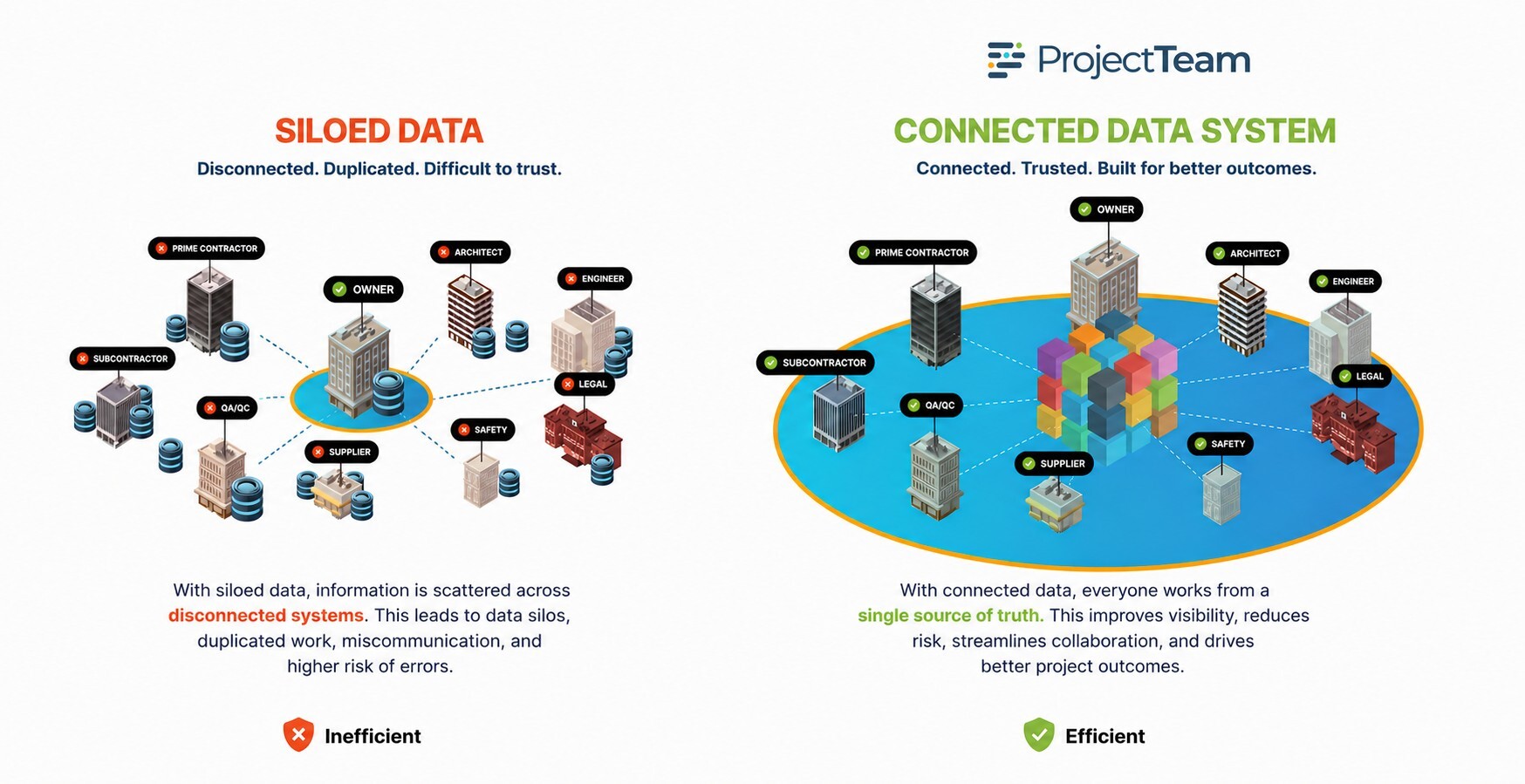
The most common approach gives one company the project environment. That company sets up the system, holds the records, and invites others in. Subcontractors, designers, and downstream participants log in to a space the host controls and work there as guests.
This model raises a question many teams ask early: Can multiple companies use the same Common Data Environment? They can, and they often do. The catch is that the space belongs to one company, so other firms work on terms the host sets and keep a separate copy of the data to stay complete.
The outcome is duplicated entry, reconciliation cycles, and project history that splinters at the company boundary. Construction information lands in data silos even after passing through a single platform.
Integrated Construction Software and the Limits of Stitched-Together Systems
A second approach keeps companies on separate systems and links them with integrations. Integrated construction software lets a firm hold data in the tools it already runs, then moves information across the gaps with APIs and file exchanges. This respects the wish to keep data in-house, and it suits teams committed to tools they trust.
The trade-off shows up in the seams. Connection points add sync delays, mapping work, and reconciliation when two systems disagree about a record. Data moves between platforms, yet the construction project still lives in pieces. Linking many systems together produces many systems with a maintenance layer on top, and the single, current project record stays out of reach.
A Common Data Environment Done Right with the CoreLink Data Model
A CDE done right takes the goal that both approaches share (a single current home for construction project information) and answers the control question in a way that fits how project teams work. In practice, it looks like this:
- Project information lives in a shared record that owners, contractors, and designers contribute to directly.
- Documents and data, including RFIs, submittals, change orders, and drawings, move between firms natively, without exporting, re-keying, or reconciling copies.
- Forms carry version control and role-based permissions, so the team has a current record and a clear history of changes.
- The company that creates a piece of information decides when it changes and who sees it.
ProjectTeam.com builds this on CoreLink Data Model, the connected architecture behind the platform. The model joins the project team in a shared record while leaving each firm's information in its own hands, connected where collaboration helps and private where a company needs it.
Audit in Construction and Who Controls the Record
Control of a record comes down to one question: Who can change it? In a single-owner environment, that authority sits with the host. A CDE done right keeps information under the control of the company that created it, so the originator decides when it changes and who sees it.
The principle predates the software market. ISO 19650, the international standard for managing construction project information, builds the same idea into its definition of a CDE, holding information under its originator's authority as the project shares and reuses it.
That control is what gives an audit trail in construction its weight. When a form carries full version history, the team can trace who changed an entry, when, and why, down to the field level. Strong construction document control keeps that trail intact, so the documentation stands up when a dispute, a claim, or a compliance review puts it to the test.
Construction Workflow Management on Your Own Terms
Control reaches past the record to the process around it. With no-code tools, a construction organization builds the forms, fields, and approval workflows its business needs and keeps that setup to itself.
A general contractor can route RFIs through an engineering review while a specialty trade runs submittals through a separate chain, and both still draw on the common project record. Workflows can lock a form after a step or automate the start of the next one, moving work along using the rules a team sets. That mix of a shared record and private setup is the heart of a connected approach to construction collaboration software.
What Happens to Your Project Data at Closeout
A construction project is a temporary enterprise. A group of companies forms at award, works together for the life of the job, and goes separate ways at closeout. That reality raises a question worth asking before the work starts: What happens to project data after a construction project closes out?
In a single-owner environment, the answer is tied to the host. The information lives in that company's system, so when the job and the relationship end, other firms keep only the copies they exported along the way, and their direct access ends with the project. That leaves several parties exposed:
- The owner who needs the full project history to operate the finished building.
- The contractor who may rely on the documentation to defend a future claim.
- The trade contractor that wants proof of the work it perform
All of them depended on a system someone else controlled.
A CDE done right avoids that exposure. Because a construction company keeps control of what it contributes inside the connected project, that information stays with its originator after the group disbands.
The project history stays coherent for the firms that need the full picture, and the companies that created each piece keep what they brought. Closeout becomes a clean handoff of a complete project history, and firms leave with what belongs to them.
Capital Program Management Across a Portfolio
For owners and program leaders, connected data pays off even after a single job. Capital program management involves running many construction projects at once, with a different mix of contractors and consultants on each. Because of this, it becomes difficult to see the whole portfolio clearly. It’s even more challenging when projects sit in separate hosts' environments. At that point, portfolio visibility turns into chasing data across systems those hosts control.
The Common Data Environment model changes that. Because the contributing firms work inside a single structure while keeping control of their information, an owner sees across its projects without taking that control from anyone. Program reporting draws on live data from active jobs, so leaders track cost, schedule, and risk across the portfolio with current numbers. This is what ProjectTeam built for owners managing capital program management at scale, with visibility across the construction project lifecycle from execution through closeout.
Teams weighing a construction project portfolio management system often start with dashboards and reporting features. The deeper question is whether the data underneath links across projects and firms at all. Connected data is what makes portfolio insight honest, because the reporting reflects the whole program.
Connected Data and AI in the Construction Industry
The way a platform handles project data sets the ceiling for what AI in the construction industry can do with it. AI reasons from the data it can reach. When that data sits inside one company's silo, its view stops at the company boundary. When the data links across the construction project, the same tools work from the full picture.
A connected architecture changes what is possible. Because the project data is already linked across firms, teams can bring the AI tools they already use and point them at real project information, with the read and write permissions the customer sets. ProjectTeam.com builds this into CoreLink as an AI-ready architecture that opens up the full project context to those tools.
This builds on the case for AI in the construction industry that connected, multi-company data is the foundation reliable AI depends on. The quality of a model's output traces back to the reach and quality of the data beneath it. Connect the data first, and the gains for construction AI follow.
A Construction Management Software Platform Built for Multi-Party Data
Multi-party construction runs on the information that many independent companies create, share, and depend on. A Common Data Environment done right respects that reality. It gives the project a single home for its information and keeps the contributing firms in control of what they bring, so collaboration strengthens the record instead of taking it over.
ProjectTeam.com delivers this as a construction management software platform built for multi-party data. CoreLink links owners, general contractors, subcontractors, and design teams in a single project record, with native data flow across firms, full version control, role-based permissions, and no-code configuration each firm controls. ProjectTeam.com is FedRAMP Certified across all modules.
See how CoreLink handles connected project data on your construction programs. Request a demo and walk through a Common Data Environment built to keep firms in control.
Frequently Asked Questions About Common Data Environments
What is the common data environment in construction?
A Common Data Environment in construction is the shared home for a project's information, where the team collects, manages, and shares documents and data through a controlled process that supports team collaboration. A CDE keeps everyone working from current records with version control and audit history, so the project runs on a single source of information the whole team can trust.
What is an example of a CDE?
A common example is a cloud platform that holds a project's drawings, RFIs, submittals, change orders, and reports in one place, with role-based access so firms reach the records they need. ProjectTeam.com is one built for construction, where the shared space runs on CoreLink so companies contribute to a single project record while keeping control of their data.
Who controls the data in a Common Data Environment?
It depends on how the CDE is built. In a single-owner model, the company hosting the environment holds the records and sets access for others.
A connected model keeps information under the control of the firm that created it, the principle ISO 19650 describes. ProjectTeam.com follows that approach, so construction firms keep control of their information while sharing a single project record.
Does a Common Data Environment require BIM?
A CDE grew out of building information modeling and the ISO 19650 standards, so the two come up together often. The concept reaches well past 3D models. A CDE manages all of a construction project's information, including documents, drawings, schedules, costs, and correspondence, so it serves a project whether or not the team uses BIM.
Is ProjectTeam.com a Common Data Environment?
ProjectTeam.com is a construction management software platform that works as a Common Data Environment built for projects with many companies. Owners, contractors, and design teams share a single project record through CoreLink, and each firm keeps control of its data. It pairs full construction functionality, from RFIs and submittals to cost tracking and scheduling, with a connected architecture that keeps firms in control of their information.