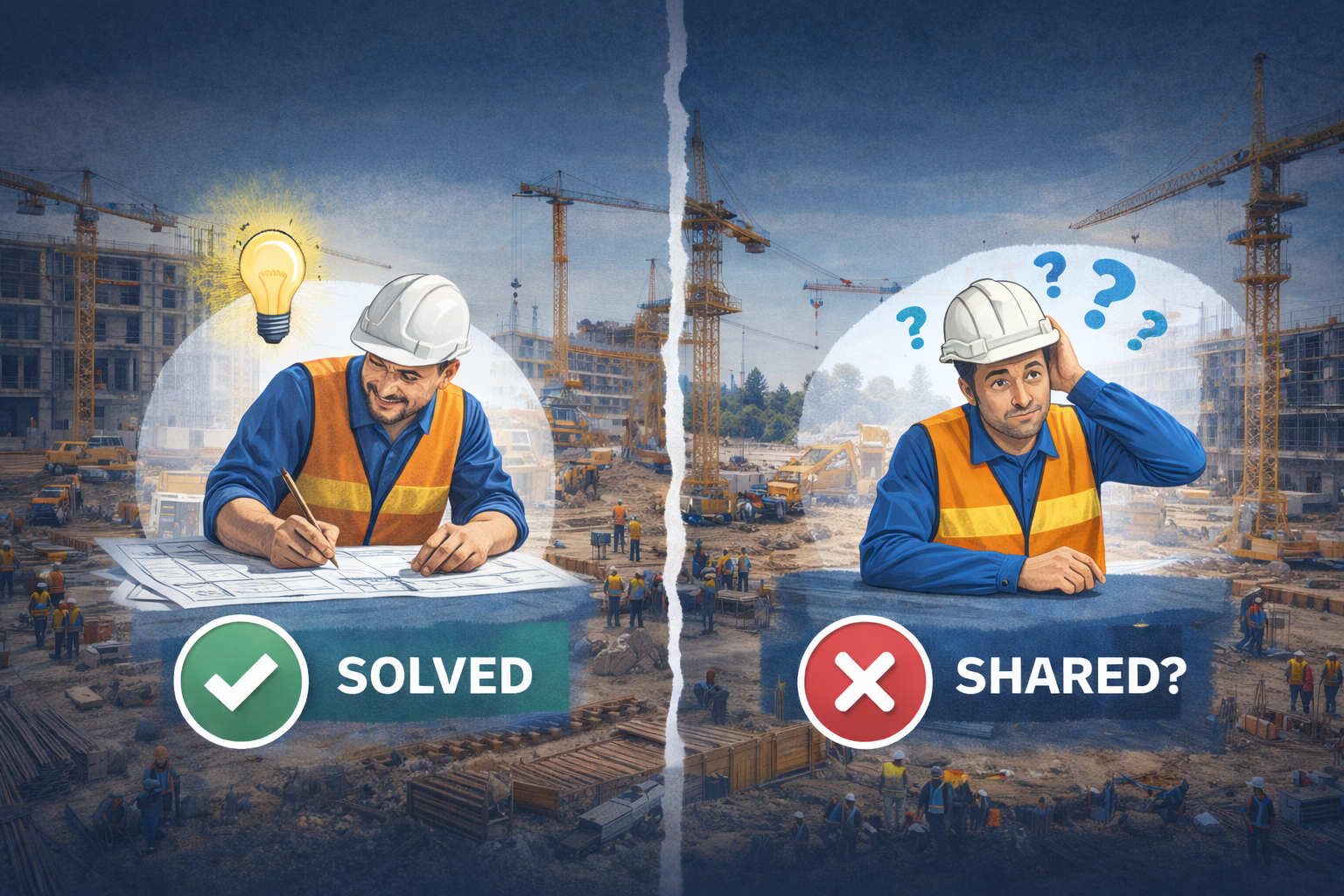
Construction is one of the few industries where a plan can be wrong by 9 a.m. and the job is still back on track by lunch. A detail gets missed, conditions change, or a delivery arrives late, and through experience, judgment, and a few quick conversations, the work keeps moving. That ability to adapt under pressure is one of construction’s greatest strengths.
It is also one of its biggest weaknesses.
While construction teams are incredibly effective at solving problems in the moment, they are far less consistent at sharing how those problems were solved. The fix works, the schedule holds, and everyone moves on without capturing the decision or making it easy for others to learn from it. Over time, those lost solutions add up, and the industry ends up paying for the same lessons again and again.
The Jobsite Superpower No One Writes Down
Construction professionals live in the gray areas. When plans do not match field conditions or something changes unexpectedly, the instinct is not to wait for perfect information but to act. Superintendents, project managers, foremen, and inspectors make real-time decisions using experience and practical judgment. Most of those decisions are smart, many are creative, and some are genuinely impressive given the constraints involved.
The problem is not the quality of the decisions. The problem is where those decisions live. Too often, they exist only in someone’s head, a notebook, a text message, or a brief conversation on the jobsite. Once the immediate issue is resolved, the solution fades into the background as the team shifts its attention to the next challenge.
Solving the Problem Feels Like the Win
Momentum is everything on a construction project. If the concrete pour is saved, the issue feels closed. If the inspection passes, the workaround worked. If the schedule holds, there is little motivation to slow down and document what just happened. Documentation feels like overhead, and sharing feels optional when the priority is keeping work moving.
This mindset is understandable, especially on busy projects with tight timelines. But it quietly creates gaps that surface later, when someone new joins the team, when a similar issue arises elsewhere, or when an owner or auditor asks why something was done a certain way.
How Good Solutions Quietly Disappear
Most lost knowledge in construction does not disappear dramatically. It fades. A problem comes up, a few people huddle, a decision is made, and work continues. Maybe an email is sent or a photo is taken, but often nothing captures the full context of the solution. Weeks or months later, the same question comes up again, and no one can quite remember the details.
The solution existed and it worked. It just never became part of the project’s shared understanding.
The Real Cost of Not Sharing
The true cost of poor knowledge sharing rarely shows up immediately. It appears when teams solve the same problem multiple times on the same project, when lessons learned on one job never make it to the next, or when decisions are questioned long after the people who made them have moved on.
It also shows up in fragmented information. When project knowledge is scattered across emails, spreadsheets, texts, and personal notes, it becomes difficult to tell a clear and defensible story of what happened and why. What felt efficient in the moment often turns into confusion later.
An Industry Built on Trust, Not Systems
Construction has always run on trust. Teams trust the superintendent who has seen it all, the project manager who keeps things moving, and the collective judgment of experienced professionals. That trust is earned and essential to getting work done.
But trust does not scale as projects grow larger, teams become more distributed, and accountability requirements increase. At a certain point, relying on memory and informal communication stops working, not because people are careless, but because the complexity has outgrown the process.
Sharing Is Not Bureaucracy, It Is Respect for the Work
There is a quiet irony in all of this. Construction teams come up with excellent solutions every day, solutions that reflect deep experience and creativity. Those solutions deserve to be captured, shared, and reused. Not to slow teams down or add red tape, but to respect the effort that went into solving the problem in the first place.
When solutions are shared clearly and in context, they stop being one-time fixes and start becoming institutional knowledge that benefits everyone involved.
Why This Challenge Is Getting Harder
Modern construction projects involve more stakeholders, more oversight, and more scrutiny than ever before. Owners expect transparency, agencies expect traceability, and teams want fewer surprises. At the same time, people are juggling more tools, more systems, and more notifications, which makes it easier for information to end up everywhere and nowhere at once.
The industry has not lost its ability to solve problems. It has simply outgrown the informal ways it used to share them.
The Opportunity in Front of the Industry
Construction does not need to become slower or more bureaucratic to improve how it shares knowledge. It needs systems that work the way construction teams already operate. Systems that capture decisions as part of the workflow rather than as an extra task, and systems that make it easy to understand why something was done, not just that it was done.
When sharing becomes a natural byproduct of doing the work, the industry moves forward without sacrificing speed.
Solving Problems Is the Skill. Sharing Them Is the Multiplier.
Construction teams will always be great problem solvers. That is not going to change. The teams that pull ahead will be the ones that figure out how to make those solutions visible, reusable, and trusted across projects and organizations.
Because the best solution in the world does not help anyone if it disappears the moment the next issue shows up. And in construction, the next issue is never far away.
Turn Great Solutions Into Shared Knowledge
Construction teams will always be great at solving problems. The real opportunity is making sure those solutions do not disappear once the issue is resolved.
If your team is thinking about how to capture decisions, share context, and keep hard-won knowledge accessible across projects and organizations, it may be time to look at tools designed around how construction actually works.
Explore how ProjectTeam helps construction teams turn everyday problem solving into shared, reusable knowledge without slowing work down.
Because the best solutions deserve to live longer than the moment they were needed.