Poor photo documentation is one of the most common and costly oversights on modern construction projects. Every day on a jobsite, field teams photograph progress updates, site conditions, inspection records, and punch list items. But too often they live in personal camera rolls, shared drives, or email threads with no connection to the official record of a construction project.
When a dispute arises or an audit requires documentation, those photos are either unfindable or unusable as part of a clear project history. Construction photo documentation is the visual layer of your project record, which is exactly what a construction management software platform is built to provide.
Photo Documentation in Construction Summary
-
Construction photo documentation is a formal part of the project record because every photo captured on a jobsite has potential value as evidence, a progress milestone, or an audit record.
-
Photos that live outside a construction document control system cannot be versioned, permissioned, searched, or reliably retrieved when it matters most.
-
Timestamped, attributed jobsite photos create an audit trail that supports compliance, dispute resolution, and regulatory inspections.
-
Field reports, inspections, and punch list items with attached photos give construction teams a reliable, visual account of project progress that written notes alone cannot provide.
-
The right photo documentation software integrates with the broader construction management system, connecting photos to the project activities they document.
What Construction Photo Documentation Actually Covers
Photo documentation in construction encompasses every visual record captured across the life of a project. Progress photos track work installed at each stage of construction. Site photos record existing conditions before work begins, protecting contractors from inheriting liability for pre-existing damage. Inspection photos document compliance with plans and specifications at each phase. Field observations capture safety concerns, quality issues, and notable jobsite conditions as they occur.
Traditional photo documentation treats images as informal reference material, outside of the official project record. Photos stored in folders, texted between team members, or saved to a personal device are disconnected from the construction process and the people who need them. Every photo taken on a construction site has the potential to serve as evidence, a progress milestone, a quality control checkpoint, or an audit record. The photo belongs in the project record from the moment it is captured.
The Benefits of Documenting Photos for Construction Projects
Having photo records as a part of project documentation creates accountability. When field teams document work conditions, installed materials, and jobsite activity with time-stamped images, the project gains a layer of data that written reports alone cannot provide. That data supports better decisions, faster dispute resolution, and a defensible record of what happened, when, and under what conditions.
Consider a common situation without the addition of photo records. A subcontractor completes work that is later disputed. Then, a site condition changes and the pre-existing state was never recorded. A progress claim is questioned and there is no photo evidence to support it. Gaps in photo documentation create gaps in the project record, and gaps in the project record create risk. Consistent, organized documentation with these photos in construction create clarity and protect every party involved. The true value of a construction project management solution is measured precisely in moments like these, when accurate records determine outcomes.
How Photo Documentation Supports Document Control in Construction
Document control in construction covers every process by which project information is created, stored, distributed, and retrieved. RFIs, submittals, drawings, field reports, and change orders all live within the document control workflow because they are official project records. Documenting construction photos belongs in the same system for the same reason. Photos that exist outside the document control environment are photos that cannot be versioned, permissioned, searched, or reliably retrieved.
A structured construction document control system gives photos the same framework it gives every other project record. Photos are tagged, organized, and connected to the relevant project activity. When a field team captures an image of installed work, that photo links to the relevant record rather than sitting in an isolated album. The result is a project record that is complete rather than partial, and searchable rather than scattered across devices and inboxes.
Construction Site Photo Documentation and the Audit Trail
Jobsite photo documentation in construction becomes part of the formal project record when it carries timestamps, location data, and user attribution. Those three elements transform a photo from a reference image into an auditable record. Timestamps establish when work was completed or when a condition existed, location data establishes where on the jobsite the condition or work was observed, and user attribution establishes who documented it.
Together they create an audit trail that supports insurance claims, regulatory inspections, and dispute resolution without requiring anyone to reconstruct events from memory.
Photo Sharing and Role-Based Access in Document Control
Controlled photo sharing is what separates document control from a shared drive. When photos live inside a document control system, access is determined by role and project assignment rather than by who has the folder link. Field teams upload photos in real time, project managers review them with full context, owners see the records they are entitled to see, and subcontractors access their scope without visibility into unrelated work.
Clear photo documentation shared through role-based permissions gives every party confidence that what they are seeing is accurate, current, and complete. The real-time data sharing in construction model makes this possible without creating security gaps or access disputes.
Field Reports and Photo Documentation for Construction Projects
Construction field reports are the daily record of what happens on a jobsite. Labor, equipment, weather, deliveries, observations, and progress all get logged in the field report. Photos attached to those reports give context that written notes cannot. A note that says "concrete pour completed on grid line C" is useful. Adding a photo of that pour, timestamped and attached to the field report, makes it a complete record. General contractors and their field teams produce these reports every day across every active construction project. The quality of those reports depends on the quality of the documentation attached to them.
Construction inspection software and records benefit from the same integration. When an inspector identifies a deficiency, a photo of that condition attached to the inspection record is far more useful than a written description alone. It removes ambiguity, speeds resolution, and creates a clear before-and-after record when the deficiency is corrected. Photo reports generated from field documentation give project managers and owners a reliable, visual account of project progress across every active jobsite.
Building a Repeatable Photo Documentation Workflow for Field Reports
Standardizing photo documentation within field reporting creates a consistent process across projects and teams. A report template that includes photo capture as a required step removes the variability that leads to incomplete records. Field teams know what to document, when to document it, and where it goes. Tracking that documentation across projects gives construction companies the ability to compare records, identify patterns, and demonstrate consistent quality control practices. When documenting photos is part of the workflow from the start, the field report becomes a reliable project record and not a summary of what someone remembered to write down.
Choosing a Photo Management System for Construction Projects
The right photo documentation software platform connects photos to the project activities they document, makes them retrievable by anyone with the appropriate access, and integrates with the broader construction management system rather than operating as a standalone tool. Photo management software that sits outside the project management environment creates the same problem as a personal camera roll; the photos exist, but they are not part of the record.
Look for construction photo documentation software that supports mobile capture from the jobsite, automatic organization by date and project, album creation for grouping related images, and version control for updated documentation. Apps or mobile-friendly construction management systems that allow field teams to upload photos directly from their devices without returning to the office close the gap between capture and record.
And a system that has photo documentation app features that include markup and annotation tools, photo sharing with permission controls, and photo storage within the project environment give teams everything they need to document construction sites completely. The document management and collaboration features built into a purpose-built platform go well beyond what standalone photo apps provide.
How ProjectTeam.com Handles Photo Documentation for Construction Projects
ProjectTeam.com is a construction management software platform built to manage every phase of project documentation, including construction photo documentation, within a single connected environment. Field teams can take pictures directly from any device and upload them into the platform, where photos are automatically organized by date and grouped into albums. Markups, annotations, and comments can be added directly to images, and every file carries a full view and download history. Role-based permissions control who sees what, making ProjectTeam.com a true document control environment for visual records as well as written ones.
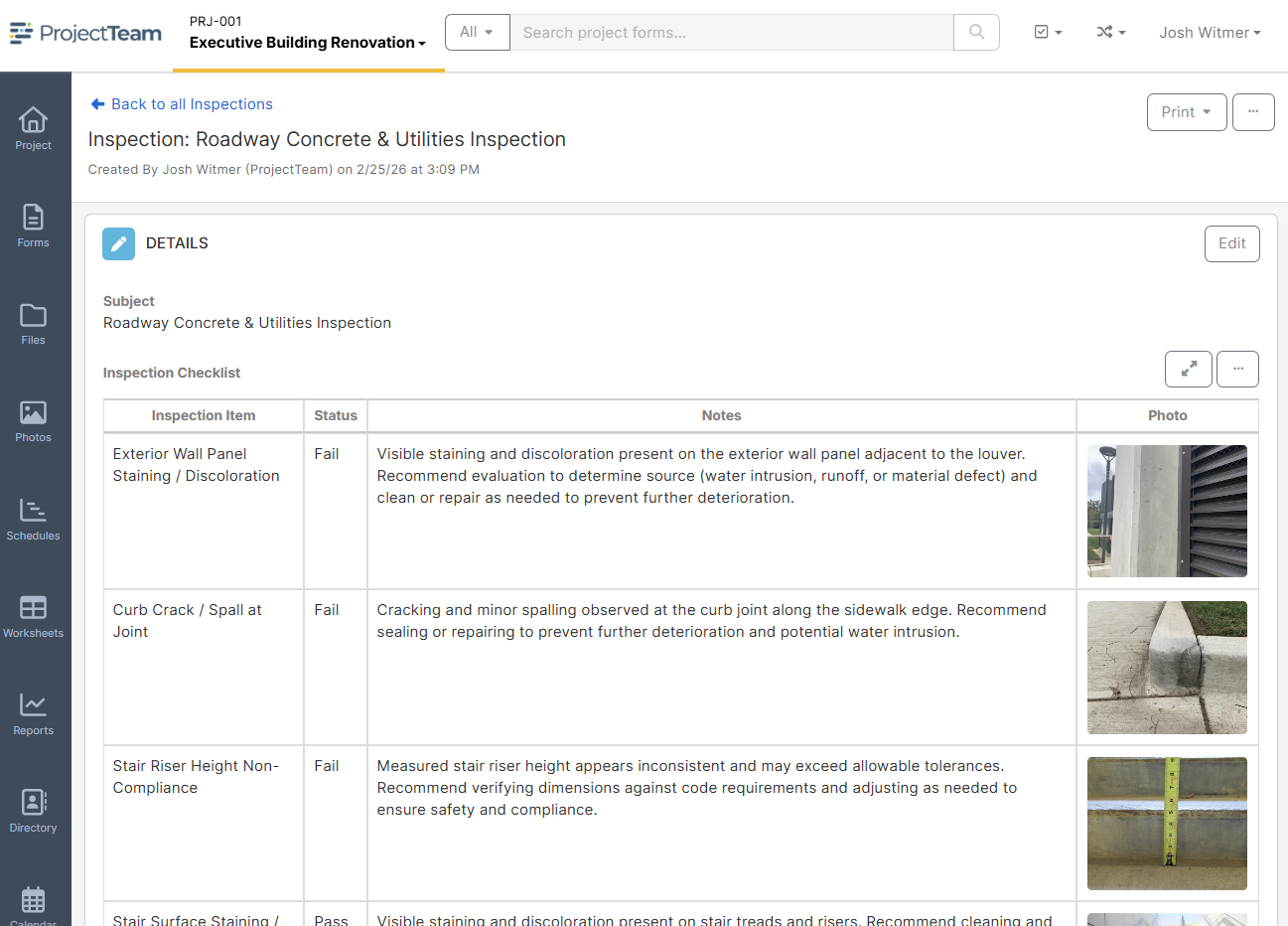
While some construction management systems may have photo organization capabilities, only ProjectTeam.com has the ability to add photo data fields directly to any form. This way, teams can avoid the cumbersome routine of opening separate record attachments and instead see the relevant photos in line with the rest of the information. Presenting project information in this format quickly provides more visual context at first glance and gives a more wholistic view in dashboards and reports.
For organizations managing government construction programs, ProjectTeam.com is FedRAMP and GovRAMP Authorized, meaning photo documentation and all other project data is handled within a secure, compliant boundary. That matters when a construction management system must meet strict data handling and audit requirements for government projects.
As a project management software in construction that covers document control, cost control, schedule tracking, and reporting in one platform, ProjectTeam.com eliminates the gap between photo capture and the official project record. To see how the platform handles files and photos alongside every other aspect of construction management, request a demo.