When organizations evaluate construction software, reviews matter. They offer insight beyond feature lists and demos and help teams understand how a system performs in real-world conditions, across real projects, with real constraints.
At ProjectTeam.com, we actively read and respond to user reviews. Not just the five-star reviews, but the four-star and three-star reviews as well. In fact, some of our most meaningful product improvements have come directly from thoughtful criticism.
Below, we highlight several recent reviews from Software Advice and explain why each one matters, what it tells us, and how we respond as a construction project management information system provider that believes software should evolve with its users.
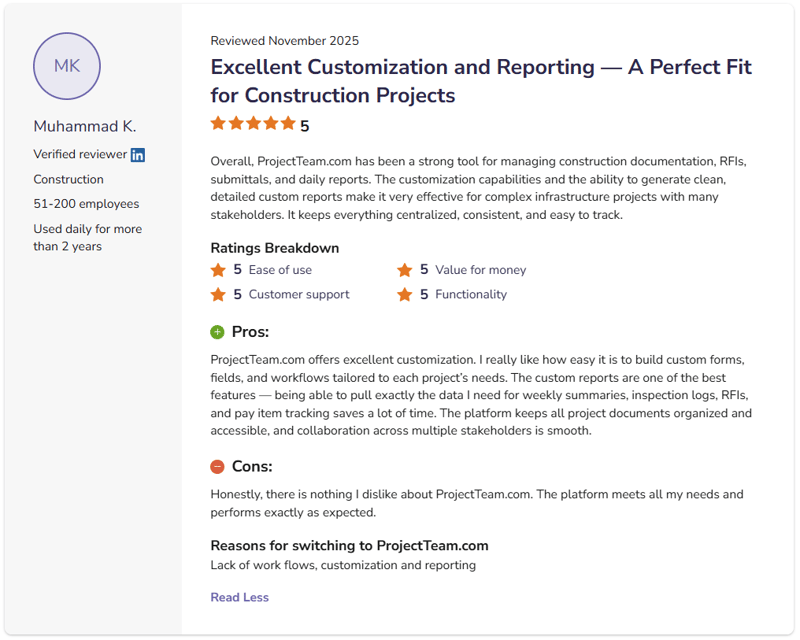
This is obviously the ideal review, and we share it here because it touches directly on the areas we intentionally focus on as a product team.
Customization is not an add-on in ProjectTeam.com. It is foundational. Construction organizations manage projects differently based on role, contract structure, funding source, and internal policy. The ability to configure forms, fields, workflows, and reports is what allows a project management information system to fit those differences without forcing workarounds.
The mention of reporting is especially important. Weekly summaries, inspection logs, RFIs, and pay item tracking are not isolated tasks. They are connected. ProjectTeam.com is designed so data entered once can be reused across reports and dashboards, saving time and improving accuracy.
Reviews like this confirm that our approach works when flexibility, organization, and collaboration come together.

This is a great review because it highlights something we did not originally support in the way this user expected. Rather than dismissing the feedback, we reached out to better understand the actual requirement.
What we learned was important. This user really liked how revision tracking worked in our submittal log. Specifically, they liked the automatic grouping of revisions and the ability to easily navigate between them. However, their organization had created custom forms to track engineering documents in a way that was unique to their internal process. They wanted the same revision behavior on those custom forms.
At the time, revision tracking was available on standard submittals but not configurable for custom forms.
Instead of telling the user to change their process, our development team worked with them to extend the platform. Today, when creating custom forms in ProjectTeam.com, organizations can enable revision tracking so that any form can behave like a revision-controlled document.
This is a good example of how feedback shapes the platform. It also highlights why configurability matters. Construction software should not limit functionality based on whether something is “standard” or “custom.”
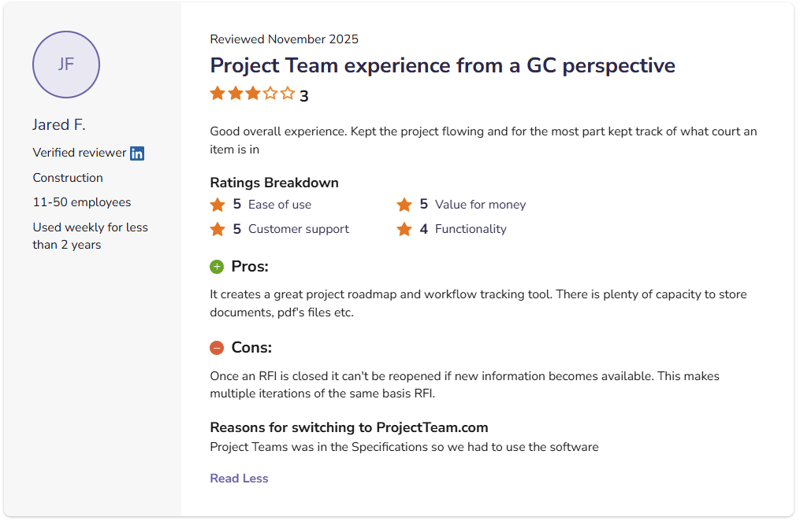
This feedback is valid, but it also highlights how construction workflows vary by role.
In ProjectTeam.com, organizations can choose to lock forms after a certain point in the workflow. Locking prevents changes and is often used intentionally for auditability, contractual clarity, and compliance. This is particularly important for owners, public agencies, and teams operating in regulated environments, including those using FedRAMP construction software.
However, locking is not a requirement. It is an option.
Some teams prefer RFIs to remain editable or reopenable. Others want a clear record that once an RFI is answered and closed, it cannot be modified. Both approaches are legitimate, depending on the project and the organization’s responsibilities.
Rather than enforce one model, ProjectTeam.com allows organizations to configure locking rules based on their needs. Feedback like this helps us ensure that those options are clearly understood and implemented in a way that aligns with user expectations.
Why We Value Every Review
If you are evaluating the best construction software, reviews should not be read as pass or fail. They should be read as insight.
A strong project management information system is not one that avoids criticism. It is one that listens, adapts, and improves. The same is true for platforms operating in secure environments. For organizations requiring FedRAMP construction software, responsiveness, transparency, and continuous improvement matter just as much as security controls.
At ProjectTeam.com, reviews influence product direction, documentation, and how we support our users. They help us validate what is working and identify where flexibility, clarity, or capability can be improved.
Final Thoughts
Construction projects are complex. No single system can anticipate every workflow, role, or requirement out of the box. What matters is whether the software gives you the tools to adapt.
By listening to real feedback, both positive and critical, we continue to evolve ProjectTeam.com into a flexible, secure, and practical platform for managing construction projects at every scale.
If you are researching the best construction software for your organization, we encourage you to look beyond feature lists and marketing claims. Read the reviews, ask how vendors respond to feedback, and see how easily the platform can be configured to reflect how you actually run projects.
If you would like to see how ProjectTeam.com supports real-world workflows and adapts to your requirements, request a demo to explore the platform firsthand.