Construction Project Collaboration Software for Federal Agencies
Federal agencies often contribute to the same construction program, even when they have different responsibilities. Agencies already coordinate that work through joint programs, partner offices, and shared funding initiatives. The challenge is that project records often remain scattered across separate systems, making it harder to follow the full history of the work.
When sister agencies work from a single project record, a project that crosses agency lines keeps one history from start to finish. Construction project collaboration software makes that possible by connecting the documentation, decisions, and approvals behind the work.
Construction Project Collaboration Software Summary
-
Federal agencies often collaborate on capital projects together, and the decisions, approvals, and documentation behind the work are just as important as the construction itself.
-
Efforts such as the Federal Lands Highway office and the Legacy Restoration Fund put several agencies on joint construction work.
-
When RFIs, submittals, and inspection reports move with the project, every partner involved works from one history.
-
Agencies decide what they share, and administrators can limit access down to individual fields on a form.
-
ProjectTeam.com supports the National Park Service (NPS) construction program on a FedRAMP Certified platform that other agencies can adopt through their authorization process.
Connected Data Turns Federal Agencies Into Construction Partners
Federal agencies often contribute to the same construction program, even when they have different responsibilities. Agencies already coordinate that work through joint programs, partner offices, and shared funding initiatives. The challenge is that project records often remain scattered across separate systems, making it harder to follow the full history of the work.
When sister agencies work from a single project record, a project that crosses agency lines keeps one history from start to finish. Construction project collaboration software makes that possible by connecting the documentation, decisions, and approvals behind the work.
Construction Project Collaboration Software Summary
Federal agencies often collaborate on capital projects together, and the decisions, approvals, and documentation behind the work are just as important as the construction itself.
- Efforts such as the Federal Lands Highway office and the Legacy Restoration Fund put several agencies on joint construction work.
- When RFIs, submittals, and inspection reports move with the project, every partner involved works from one history.
- Agencies decide what they share, and administrators can limit access down to individual fields on a form.
- ProjectTeam.com supports the National Park Service (NPS) construction program on a FedRAMP Certified platform that other agencies can adopt through their authorization process.
Where Federal Construction Already Crosses Agency Lines
Interagency collaboration is a long-standing part of federal government construction. Some of the clearest examples come from the agencies that manage public land, where capital projects regularly involve more than one bureau or department.
Sister Agencies Within the Department of the Interior
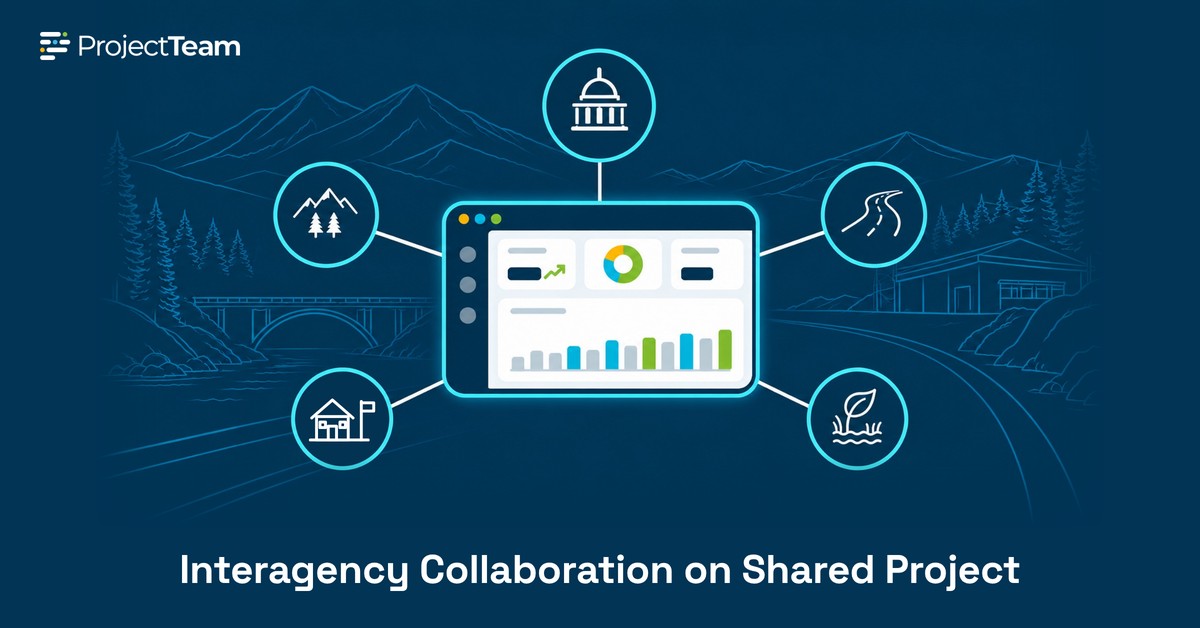
The Department of the Interior (DOI) is made up of sister agencies with related missions, from the National Park Service (NPS) to the U.S. Fish and Wildlife Service (USFWS). The NPS alone manages more than 400 park units across the country and its territories. Because these agencies oversee neighboring land, their construction work often lands in the same regions. Some projects serve the land that are managed by multiple agencies . Those overlapping responsibilities create a natural need for coordination throughout the life of a project.
Federal Lands Highway Projects for Eight Partner Agencies
Road work on federal land shows how this coordination runs at scale. The Federal Highway Administration (FHWA), through its Federal Lands Highway office, works with eight partner agencies across three departments, including the NPS and the U.S. Army Corps of Engineers (USACE). FHWA manages those projects from planning through construction, giving partners with very different missions a common way to deliver the work.
Legacy Restoration Fund Repairs Across Five Agencies
The Legacy Restoration Fund (LRF) applied a similar idea to repair work. From fiscal year 2021 through 2025, it funded deferred maintenance projects at four Interior bureaus and the U.S. Forest Service (USFS), which sits within the Department of Agriculture (USDA). One program connected the funding, while each bureau chose projects based on its mission. According to the DOI, more than 130 of those projects had completed construction by June 2026.
What Connected Data Changes for Government Construction
Behind each of the above programs is a steady flow of project information moving between agencies and their partners. When that information lives in separate systems, understanding the full history of the project becomes much more difficult.
The Project Information Agencies Exchange on Joint Work
On a joint project, agencies and their contractors exchange requests for information, submittals, inspection reports, and change orders throughout design and construction. Each of those records passes through several hands before it is closed. When agencies keep those documents in one connected project record, every agency on the project works from the current version and can see how it changed over time.
What a Single Project History Gives Each Agency
A single history is especially useful when people join or leave a project. For example, a bureau that enters a project partway through design can review earlier decisions, approvals, and comments directly in the project record. Its staff can pick up the work with the full context in hand.
Department leaders gain a similar view across their capital programs. They can follow the status of federal construction projects in several bureaus from the records the agencies already keep. Many owners and contractors work this way on multi-company projects, using a model called connected collaboration.
Shared Construction Projects With Each Agency in Control
Sister agencies on a shared project each hold information meant for their staff alone, from budget details to internal review comments. Collaboration across agency lines works when each agency controls who sees that information. A well-run common data environment on a multi-party project follows that principle, keeping every organization in control of the information it creates.
Deciding What Gets Shared and With Whom
On a platform designed for capital construction programs, the agency that creates a record controls who can view it. Access can be granted to individual users, partner agencies, contractors, or project groups, depending on who needs to participate.
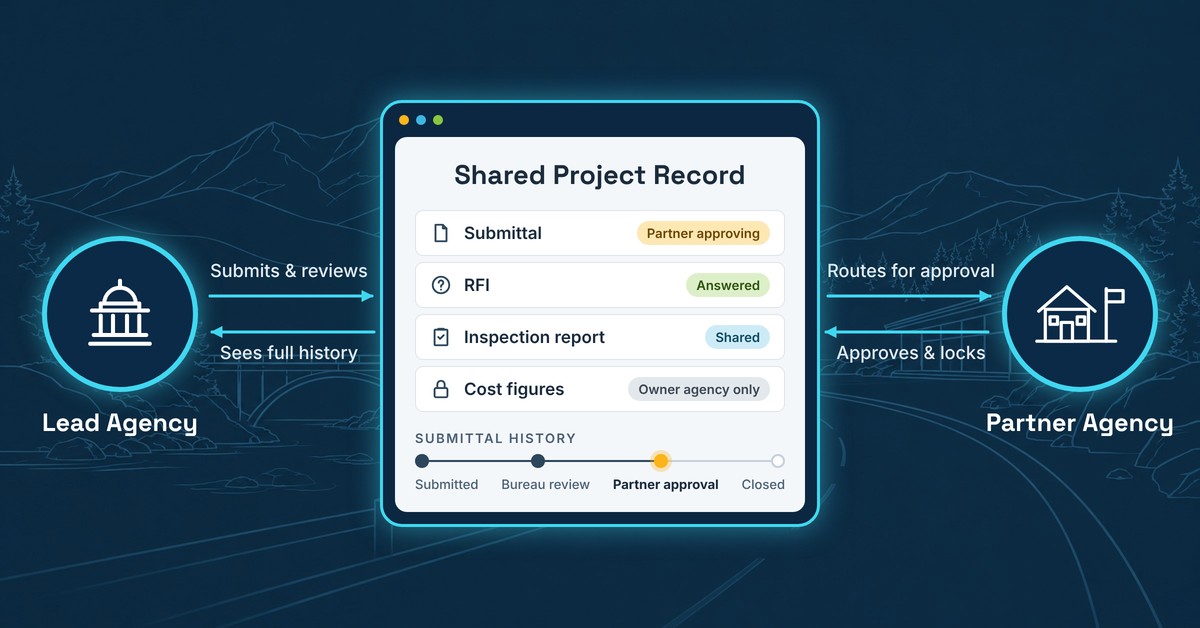
Administrators at each agency can also control access at the field level. A form may be visible to every partner agency while certain fields, such as cost figures or internal comments, remain limited to specific users or roles. This allows agencies to collaborate on the same record without exposing information meant only for their staff. Access can also be removed when a person's involvement in the project ends.
Agency Processes on Shared Records
An agency's review process reflects its mission, regulations, and the way its staff already work. Administrators at that agency can build the forms, fields, and approval workflows their staff use with no-code tools. Project templates then carry that setup into each new project the agency starts.
On a shared project, a submittal can move through one agency's review path and then into a partner agency's approval steps. Workflows can lock a form once an agency signs off or start the next review automatically. The full history stays in the project record that every partner sees.
Contractors Working Across Multiple Agencies
Contractors often deliver work for more than one government agency over the life of a program. When agencies run their projects in separate systems, contractors learn a new set of tools and submission steps as they move from client to client.
For example, a contractor delivering a road project for one bureau and a facility repair for another can work in one environment for both. Administrators at each bureau decide what the contractor can see. The contractor then submits RFIs and submittals through the workflow that bureau has set up.
When external contributors can connect for free, agencies and prime contractors can add subcontractors, designers, and consultants to a project as soon as their work begins.
Action items and notifications point contractors to what needs their attention on each project. Their submittals, responses, and approvals stay in the project history, giving them a clear record of their work at closeout and when questions come up later.
Security Authorization for Federal Construction Programs
Before an agency can put project data on a cloud platform, the platform has to meet federal security requirements. The Federal Risk and Authorization Management Program (FedRAMP) sets those requirements for cloud services across the government.
Authorization That Carries Across Agencies
FedRAMP is designed for reuse. Once a platform is authorized, other agencies can review the existing authorization package and approve the platform for their use, which spares each agency from repeating a full security review. For sister agencies working together on a project, that reuse lets each one approve the platform through its process and then work in a single authorized environment.
Agencies evaluating construction management software for government should also confirm that authorization covers the full feature set before signing a contract.
Contractors Inside the Authorized Boundary
Contractors working across several agencies look at security from a different angle. Every agency they serve has expectations for how project data is handled. When those agencies use one authorized platform, a contractor joins each new project in an environment that already meets federal government requirements.
Agencies can add contractors to a project as soon as their scope begins, with access limited to the records and fields their role requires. Each agency can also set up the forms and workflows that contractors use on its projects. The obligations for federal construction contractors still apply. Working inside one authorized boundary lets contractors meet them on every agency's project.
What to Look for in a Federal Construction Management Platform
A platform for joint federal work has to handle several project stakeholders. A few practical questions can help narrow the options:
- Can each organization decide what it shares, down to individual fields? Joint projects mix information meant for all partners with details meant for one agency. Ask how a platform handles both, and who sets the rules.
- Can agencies set up their forms and workflows on shared records? Ask whether administrators can configure review steps for their agency on a record that partners also use.
- Can outside contributors connect for free? A multi-agency program involves a changing mix of contractors, designers, and consultants. Check whether they can join at no cost when their work begins.
- Does every record keep a full audit history? Look for version history that shows who changed what and when on every form and document. Reviewers rely on that history during oversight, audits, and disputes.
- Does authorization cover the full feature set? Some platforms limit features inside their authorized environment. Confirm that the tools agencies plan to use are included.
Program-Level Visibility Across Agencies
Department leaders often oversee capital programs that span many projects and several bureaus. To track status, budget, and schedule across that program, they often collect updates from contractors and partner agencies.
Capital program management software pulls that information into consolidated reports and dashboards. Leaders can track financial performance as costs come in. Project templates help them keep processes consistent from one project to the next.
With every agency's records in one place, leaders can check progress directly.
Construction Project Collaboration Software for Connected Federal Agencies
The National Park Service (NPS) offers a working example of a federal agency running its construction program on one platform. Staff and outside partners across the country work from shared project records, on a system authorized for federal data. It shows what becomes possible when an agency's construction work lives in one place.
National Park Service Projects on ProjectTeam.com
NPS has used ProjectTeam.com for project documentation since late 2023. NPS chose a FedRAMP Certified platform that could connect its staff with outside partners across every region and territory. Teams across the country now follow consistent processes wherever they work.
How ProjectTeam.com Supports Joint Agency Work
ProjectTeam.com gives agencies and their partners these capabilities for cross-agency work.
- Records that stay private until shared with users, companies, or project groups
- Field-level security set by administrators
- No-code forms and workflows for each agency
- Version history and audit trails on every form
- FedRAMP Certified and GovRAMP Authorized
ProjectTeam.com is a construction management software platform designed for capital programs where several organizations deliver the work together. Agencies can use it as construction project collaboration software, keeping one project history for all partners on a joint project. To see how it supports work across agencies, request a demo.
Frequently Asked Questions About Federal Construction Collaboration