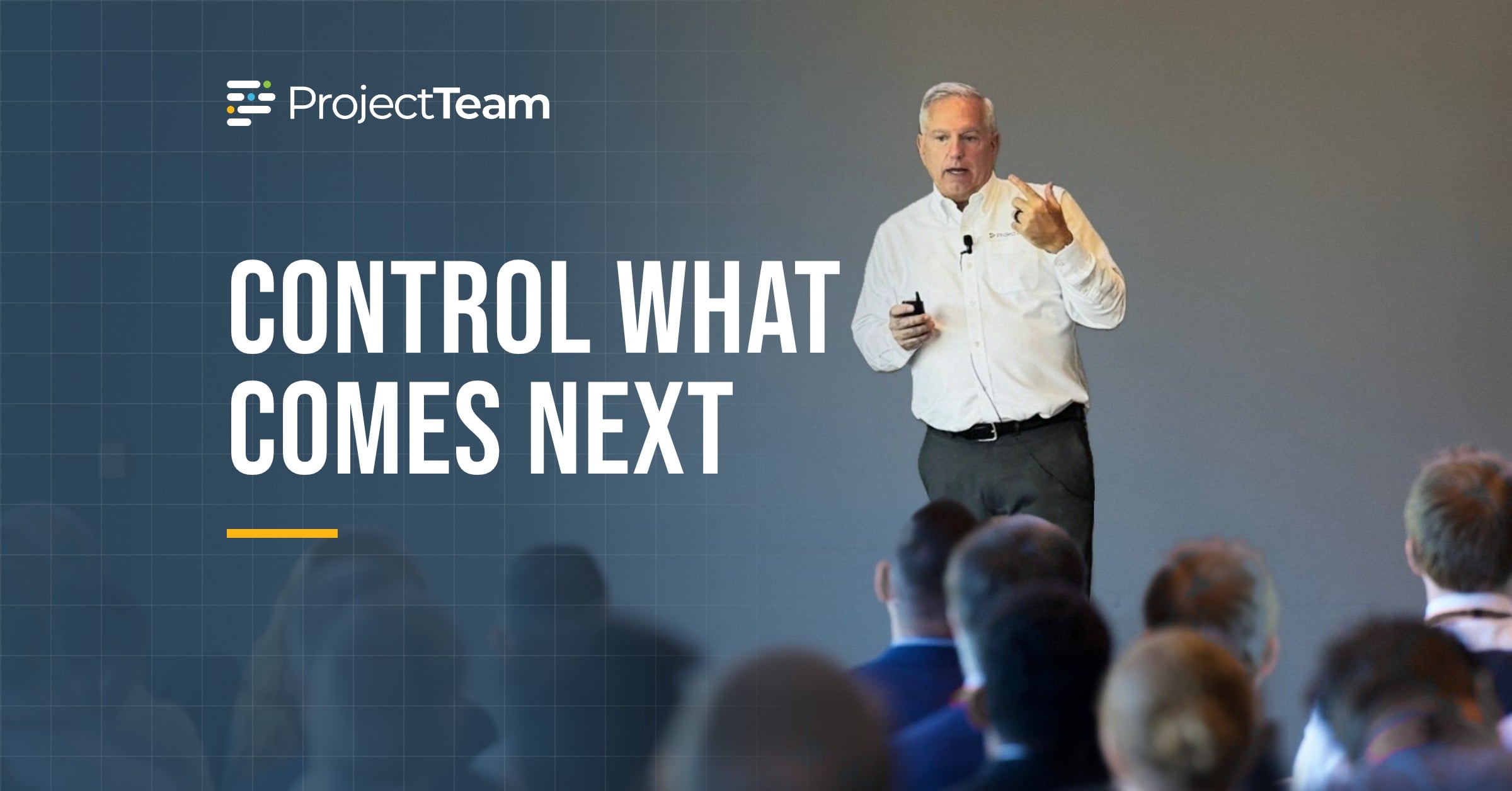
At Project Controls Expo USA 2026 in Washington, DC, ProjectTeam's Founder and CEO, Ty Witmer, presented alongside Brent Miller of the Maryland Stadium Authority on what it takes for an owner to stay in control of a growing capital program. Continue reading for Ty's takeaways from the session.
A few weeks ago at Project Controls Expo USA, I had the privilege of sharing the stage with Brent Miller, Project Director in the Capital Projects Development Group at the Maryland Stadium Authority. Our session was called “Control What Comes Next,” and I built it around a question I hear from just about every owner I talk to these days: how do you hold onto control of a capital improvement program when the data, the teams, and the expectations are so fragmented?
I want to walk you through how I answered that on stage, where Brent came in, and the one thing that stuck with me most from the whole week.
Where the System Breaks Down
I started the session by saying owners have the right idea when they decide to implement a modern platform for managing their capital program. The problem is that many of the systems on the market today end up being the reason the initiative fails. We have all seen platforms that looked great in the demo and fell apart in practice, and when you ask why, the same handful of reasons keep showing up. I grouped them into four, because once you can name them, you can do something about them.
Disconnected
The first problem is that most systems keep each stakeholder’s data in its own silo. Your cost sits in one system, your documents in another, and your schedule off in a third, while the owner, designers, and contractors each work from their own version. Moving information between them is slow, opens a security gap every time a file changes hands, and leaves people entering only the bare minimum. The full picture only exists once someone sits down and builds it by hand, and by then the window to act has usually closed, so decisions get made on information that is a few steps behind reality.
Too Rigid
The second is rigidity. Instead of the system bending to fit how your team works, your team ends up bending to fit the system. The processes you have refined over years get reshaped to match whatever the software expects, your real requirements turn into workarounds, and every little change you need waits in some vendor’s queue until it reaches the top of their roadmap. You end up managing the workarounds as much as the program.
Not Secure
The third is security, and it tends to hide in plain sight. The moment your records get downloaded and emailed around, every person with a copy becomes a point of exposure. There is no single place where the data lives, no shared history of who changed what, and when an audit or a dispute arrives and you need one clean trail to point to, it is not there to pull.
Expensive
The fourth is cost, which has a way of creeping well past the number everyone agreed to. The real expense is usually time. It can take months, sometimes years, before the system works the way it was supposed to. Every week that it sits half-configured is a week that the program runs without the visibility it was meant to provide. By the time the rollout catches up, the real price has little to do with the number on the contract.
None of that is meant to be gloomy; it is just the opposite. Once those four are out in the open, the path forward gets a lot clearer.
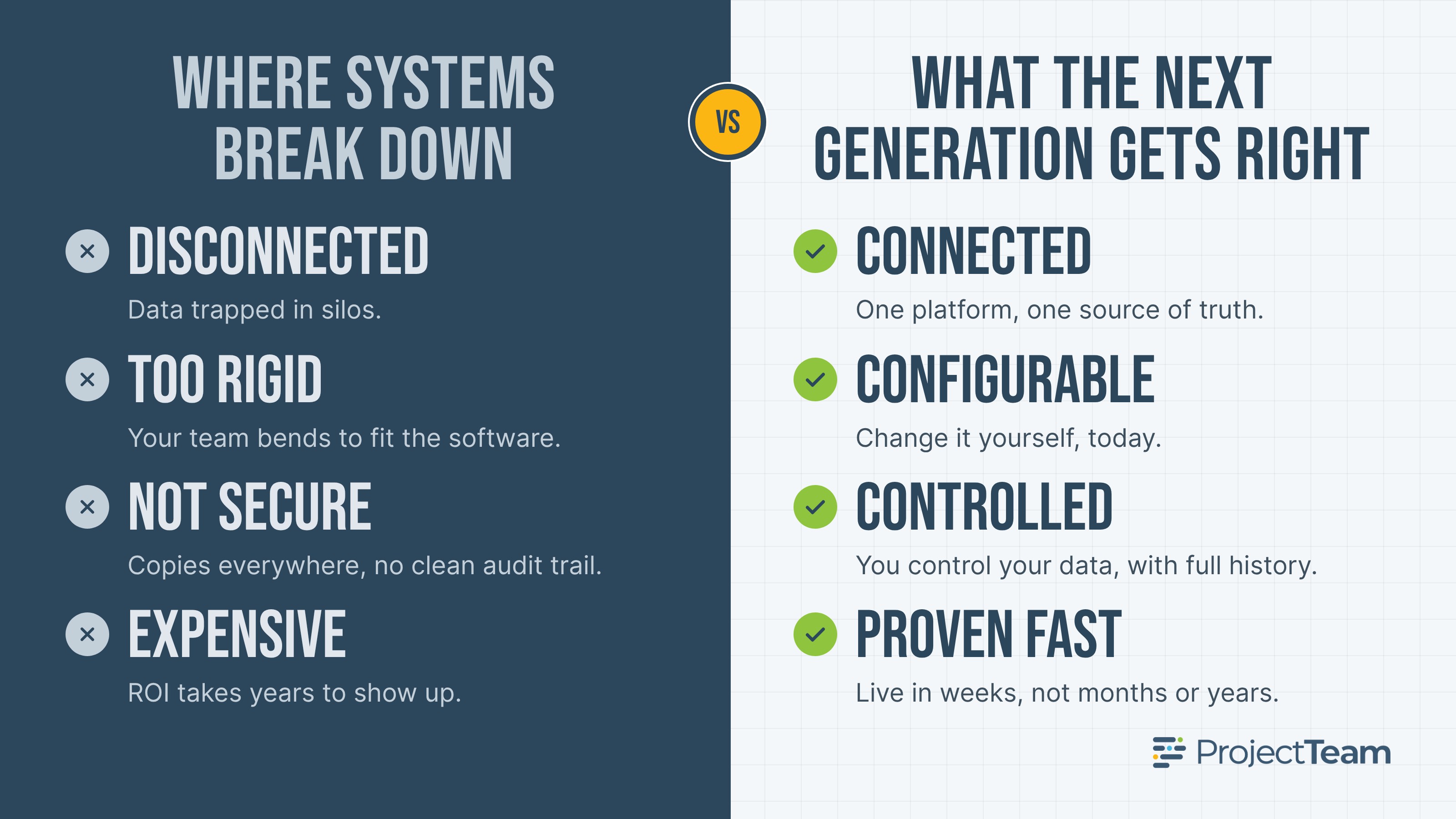
The four ways most systems let owners down, and the four things the next generation gets right.
What the Next Generation Gets Right
The heart of my talk was showing that each of those four failures has a direct answer, and that owners no longer need to settle for getting some of them right and living with the rest.
Connected
When the platform is connected, every organization on the program, from the owner and construction manager to the design team, general contractor, and subcontractors, joins the same project record as its own company. Nobody is a guest in someone else’s system. When the GC submits an RFI or a pay application, the owner sees it the moment it is sent, with no email attachments, no re-keying into a second system, and no waiting on a nightly sync. Because each company keeps ownership of the data it shares, everyone works from the same version of the truth.
The piece that makes this work is the CoreLink Data Model™. It is the architecture underneath the ProjectTeam.com platform that ties every organization’s records into a single shared project record, so the data on a capital program finally comes together in one place instead of scattered across separate systems.
Configurable
When the platform is configurable, it works in harmony with your processes instead of against them. Your administrators set up the forms, fields, workflows, and reports themselves, right from the interface, at no extra charge. The platform adapts to your team as their needs change.
Controlled
Bringing the data together does not mean handing it over. Each organization on the platform keeps control of its data, with full history on every record, so they can always answer what happened on a program and when. For construction teams working on federal and public programs, that control matters even more, and is the reason why ProjectTeam.com was built to FedRAMP Certified standards.
Proven Fast
When the platform is built to go live quickly, it starts paying off in weeks rather than dragging on for months. Part of that speed comes from the configurability, since the system fits your processes from the start. The rest comes from adoption. When a platform is straightforward to work in, people actually use it, and a system only delivers value when the team is on it.
What It Looks Like From the Owner's Seat
Here is where I stepped back and handed the presentation over to Brent, because honestly, his session was the most worthwhile part as someone who has been through program management technology implementations from the customer side.
The Maryland Stadium Authority is the construction arm of the State. It carries bonding authority for state-funded programs and runs a portfolio that stretches across school construction, blighted property demolition, and statewide studies. That is a lot of work happening at once for one agency to keep a handle on.
Brent was refreshingly honest about what work-life looked like before. The systems MSA had been using were rigid, more complicated than they needed to be, and thin on support. They kept dictating how the agency had to operate rather than supporting the way MSA already worked. The forms in the system were preset, routine tasks buried people in clicks, and the upkeep was left to the MSA project team, who already had plenty to do.
What turned it around was moving to ProjectTeam.com and putting the configuration in MSA's hands. The agency sets its standards now, makes adjustments as needed, and runs its cost, its approvals, and its reporting off one connected record. Training stayed light because the layouts felt familiar from day one, and the reporting finally reached across the whole portfolio instead of one project at a time. The way Brent puts it stuck with the room: when the platform is built around how the agency actually runs its programs, people adopt it, and the payoff shows up in the numbers.
The Real Question About AI
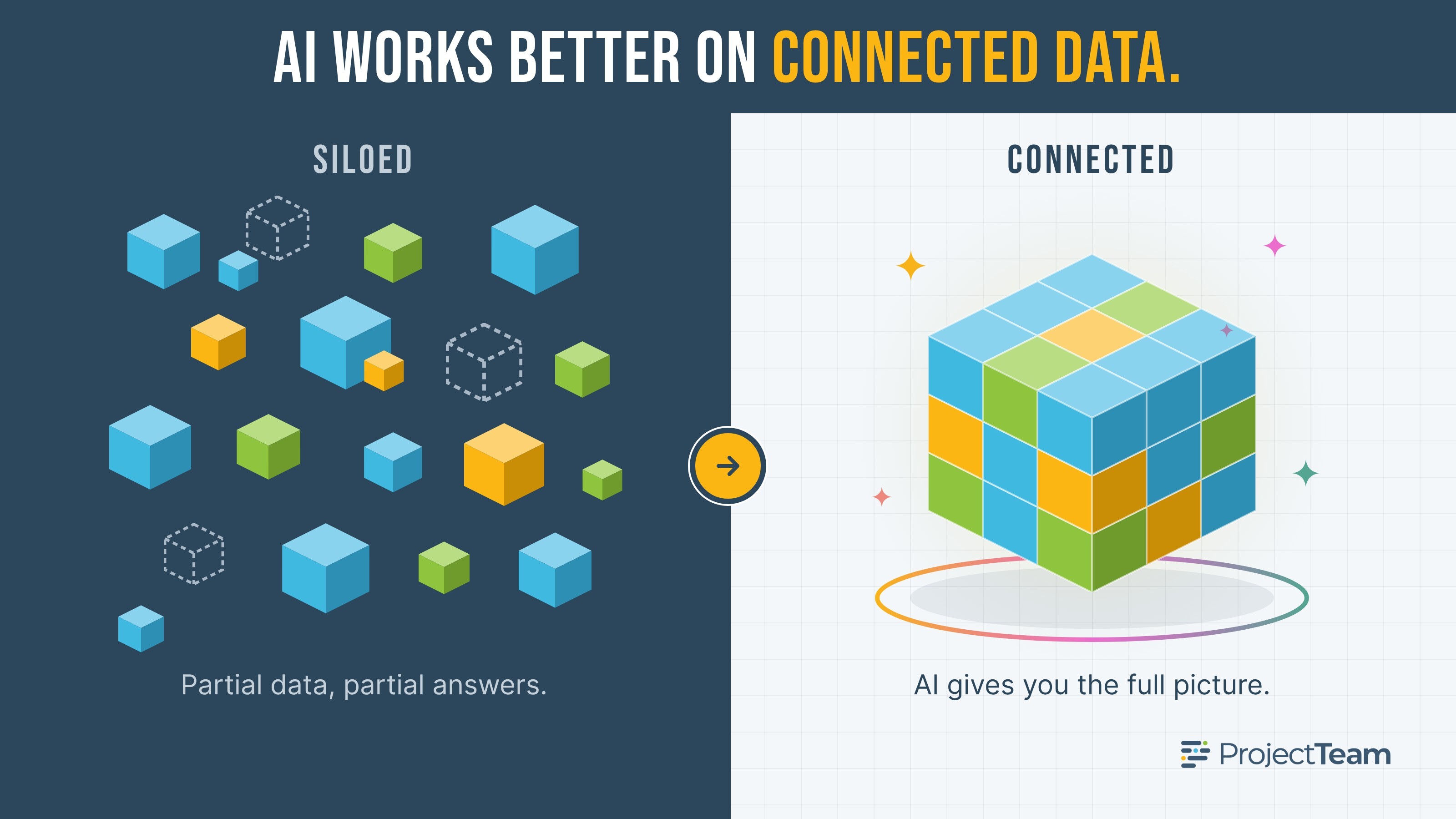
Siloed data gives you partial answers. Connected data gives AI the full picture.
Then I came back up to close out the topic, and spoke on the emerging use of artificial intelligence, and I pointed out what I thought was the biggest take-away from the session.
The industry has stopped arguing about whether AI belongs in project controls; that debate is over. What people are asking now is how to bring it in so they can trust what it gives them, and the answer to that starts underneath the AI, with the data. AI is only ever as good as the records it can see.
When every organization on a program contributes and keeps control of its data, the AI finally has the full picture to work from, and that is what makes its answers worth acting on. Get the data model right first, and AI stops being a fancier way to report what already happened and starts helping you plan what comes next.
That is the whole idea. Controlling what comes next is not about predicting the future, it is about building a foundation solid enough that the future does not catch you off guard.
If you are evaluating a new capital program management platform, start with the four questions we left the room with:
- Is it connected?
- Is it configurable?
- Is it controlled?
- Is it proven to go live fast?
Thank You
A big thank you to Brent Miller and the Maryland Stadium Authority team for being real partners, and to everyone who came out to Nationals Park and stuck around to ask questions. If you are an owner thinking through how to keep control of your capital program, our team would be glad to walk you through what this looks like on a program like yours. You can schedule a demo whenever you are ready.